Grottaglie Ceramics - Authentic Made in Italy
Today's ceramics: current productions that tell stories of the past
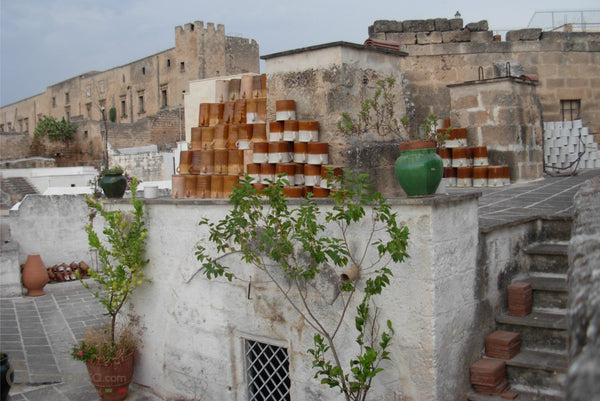
The city of Grottaglie is in Puglia, about twenty kilometers from Taranto, and is part of the Italian Association of Ceramic Cities, a network of 36 Italian municipalities with an ancient ceramic tradition, identified by the CAT mark (TRADITIONAL ARTISTIC CERAMICS). The many artisan workshops in Grottaglie are located in the Ceramics District, just outside the city's historic center. The oldest workshops are carved into the limestone and preserve the ancient kilns, also built by hand; large basins for settling the clay; large courtyards with irregular stone-paved floors, spacious vaulted rooms, terraces and hanging gardens, as well as ancient underground oil mills, cisterns and caves.
The Ceramics District of Grottaglie preserves practically the entire history of local artisan production, often retaining its original appearance and enchanting tourists from all over the world. Today, ceramics are made mainly for interior and exterior decor and tableware. Modern technology is used to prepare the clay and colors, but some stages of the work, such as shaping and decorating, still require the skill and experience of the master ceramicist.
Traditional objects that embody ancient local legends
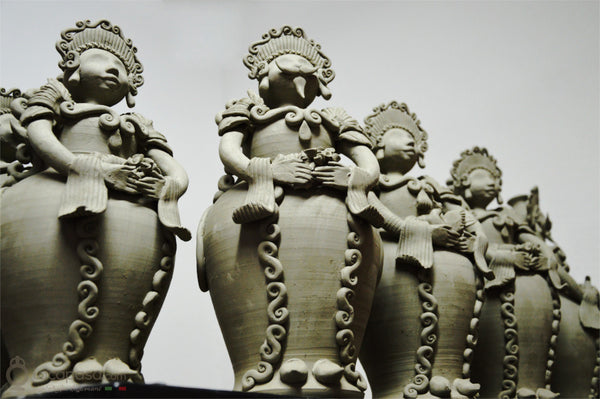
The Dolls of Grottaglie are anthropomorphic bottles that embody the legend of ius primae noctis. According to this custom, all the young brides in the town were forced to spend their wedding night with the ruling prince. The story goes that a farmer, consumed by the thought that his wife would also have to endure this outrage, decided to take revenge by killing the evil prince. He disguised himself as a woman and went to the castle for the appointment, but in his haste he forgot to shave off his mustache! He was discovered and mocked by the prince, who wanted to sentence him to death but instead, to humiliate him further, forced him to hand over all his wine! The farmer therefore had a considerable number of bottles made to hold his wine, bottles shaped like a doll with a mustache!
The Baroque Court on the Dresser
The Knights, with their rich Baroque costumes and horses adorned with opulent trappings, evoke the ancient Spanish rule of Puglia. They are made exclusively in Grottaglie and are genuine works of art: their finely crafted decorative details make them prestigious ornamental pieces for interiors, and they can also be turned into candleholders or ceramic lamp bases paired with large fabric lampshades.
The Pumi: Good-Luck Charms That Become Fine Decorative Objects
a bud with three leaves, symbolizing spring and the rebirth of nature, bringing new vital energy. A lucky charm that originated with the master ceramicists of Grottaglie and has won over audiences in Italy and around the world with its arabesque shape and captivating colors. Elegant decorative accessories with powerful symbolic and apotropaic meaning, authentic good-luck charms, ideal for adding character to every corner of the home.
Pine Cones: From the Cosmic Egg to the Materialization of the Soul
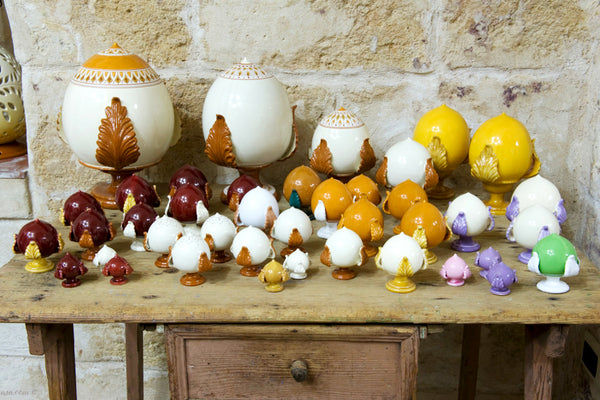
The ceramic pine cone embodies fertility, longevity and eternity, as well as the cosmic egg associated with the birth of creation, the beginning of all things. This is why this symbol has always adorned the entrance gates of historic villas and gardens, monumental cemeteries, the façades of churches and convents, and the thrones of kings and popes, as a materialization of the soul, the bridge connecting the earthly and the divine. These meanings take shape in the hands of skilled ceramic artisans who create pine cones in large and small sizes. Starting at the potter’s wheel the ceramicist first shapes the base dome, then the supporting foot, which are joined together later. L’the artisan shapes the pine cone’s seeds, one at a time, using only their fingers and attaching them to the base dome with liquid clay.
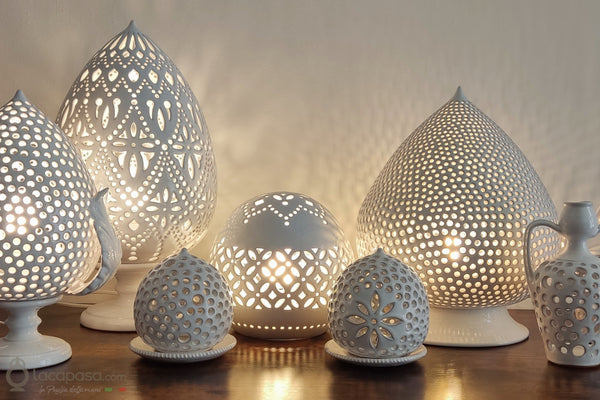
Artistic Lamps: Magical Geometries of Light
The production of objects for indoor lighting is quite recent and highly appreciated. Table lamps, desk lamps, bedside lamps, and candle holders are the result of great technical skill, as they are shaped by hand on the potter’s wheel and then finished using the perforation technique. This technique involves carving the surface of the object in raw clay when it is at an intermediate stage of drying, known as “leather-hard”: using a scalpel, the artisan carves flowers, leaves, drops, and geometric patterns, creating small works of art that, once lit, create magical plays of light.
The Rooster: a symbol deeply rooted in Apulian artisan culture
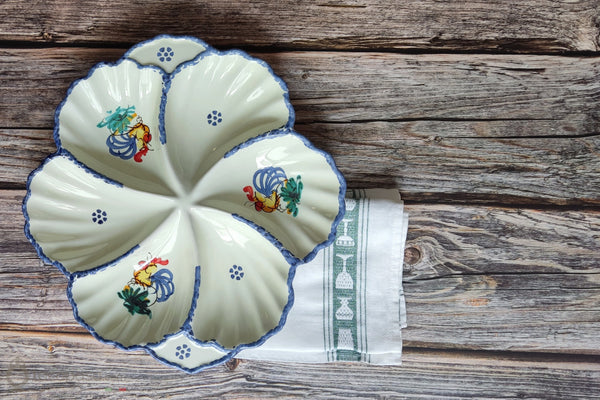
The Rooster represents the typical decoration of Apulian folk art, accompanied by the plate’s rim, decorated with a brown line and a small five-petaled blue flower . Associated with the symbol of dawn and awakening, the Rooster is an emblem of protection from evil and good health. A messenger of the sun that follows the darkness, the Rooster also represents spiritual rebirth and the triumph of truth over lies. It appears on all tableware and makes the image of Puglia recognizable around the world. Plates, pitchers, bowls, salad bowls, and glasses are coated with white or ivory glaze and decorated with the classic central rooster in a rearing pose, with a fluffy crest and plumage. The color palette used to paint it features vivid colors such as cobalt blue, copper green, bright orange, and manganese brown.