The Story - Ancient Productive Memories
Handcrafted ceramics, a testament to ancient roots
Archaeological excavations in the areas around the city of Grottaglie have uncovered fragments of vases and tools for working ceramics, pottery shards and household objects that attest to a very ancient history of production, dating from the Paleolithic through to the Middle Ages. Many of these artifacts are currently housed at the National Archaeological Museum of Taranto and at the Grottaglie Ceramics Museum.
L’clay from Grottaglie was considered to be of good quality and was extracted from quarries in the countryside around the city by experienced farmers who used large, crescent-shaped hoes called “musu”: With this tool, the farmers dug narrow, deep channels in the ground until they reached the best layer of clay. The excavation was then widened, and the lumps of clay were extracted and loaded into buckets for transport to the workshops. Here the raw clay was refined through a long and very laborious process, carried out by hand by numerous workers specializing in the different stages.
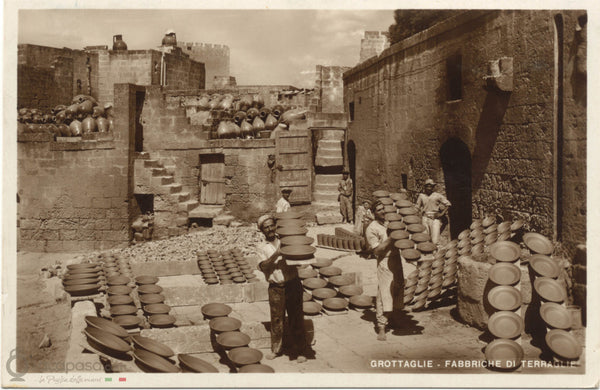
Clay refining: a long process of hard work by hand
The division of labor assigned a specific worker to each stage of refining the clay: the “palazziere” broke up lumps of clay with an iron hammer; the “stompa creta” trod the mixture underfoot to make it more malleable; the “faenzaru“ shaped the clay on the wheel to give it the desired form; the “caminaru” oversaw the firing in the kiln. A whole host of other workers and apprentices filled the workshops inside and out, along the streets of the Ceramics District, just outside Grottaglie’s historic center. Even today, this district is home to old and new artisan workshops that function as a production hub.
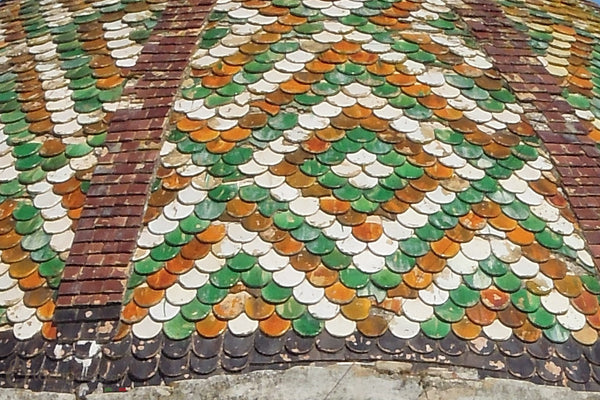
Starting in the sixteenth century many families of ceramicists have passed this craft down from generation to generation to the present day. The many religious orders that settled in the city were the main patrons of fine works such as holy water fonts, which echo the architectural designs of Baroque altars with cherubs, garlands, columns and shells, and floors made of tiles painted with botanical or geometric motifs, right up to the covering of the majestic dome of the Mother Church with colored terracotta tiles known as “scàndole“.
The eighteenth century
Eighteenth-century artisan production was intended to furnish the homes of wealthy families and, to this end, gave rise to pitchers, tureens, albarelli for holding herbs and medicinal remedies, and ciarle, decorative jars with two handles and lids, their surfaces covered with finely hand-modeled fruit, leaves, cherubs, and human heads, then coated with white glaze: the famous “whites” of Grottaglie. Today, these objects are regarded as true masterpieces that combine technical harmony and elegance.
Ceramics for the kitchen, table, and pantry: dozens of forms suited to everyday use
Throughout the nineteenth century , a third of Grottaglie’s population was employed in ceramic production, which began to take on the character of a factory rather than an artisan workshop. Grottaglie became the largest center in Terra d’Otranto for producing household pottery and containers: plates, cooking pots and pitchers, large jars with handles for storing oil and wine, such as the “capasoni,” the “capase” for preserving traditional foods, and dozens of other fascinating, rare forms that show how people have shaped clay to meet their needs. Today, these objects have lost their practical function and have become decorative items for the home, embellishing terraces, gardens, and places for relaxation or refreshment.
The Royal School of Ceramic Art of Grottaglie: a school spanning a century
Alla fine dell’Ottocento il Ministero Italiano dell’Agricoltura Industria e Commercio istituì a Grottaglie la Regia Scuola d’Arte allo scopo di formare gli artigiani per migliorare le procedure tecniche con l’acquisto di attrezzature per purificare le argille, i torni meccanici per la modellazione degli oggetti, i fornelli per la cottura dei minerali e nuovi forni per la cottura a temperatura controllata. Ma il ceramista grottagliese, abituato a lavorare duramente tutto il giorno e dotato di uno scarso livello d’istruzione, trovava serie difficoltà a seguire gli insegnamenti della scuola e di conseguenza a staccarsi dai vecchi sistemi di produzione.
Despite these difficulties and the two successive wars, the school received highly prestigious national recognition and helped bring local craftsmanship beyond the provinces. This ancient institution still exists today as the ”Vincenzo Calò” Art High School , passing on the same goals to new generations and preserving local historical memory.
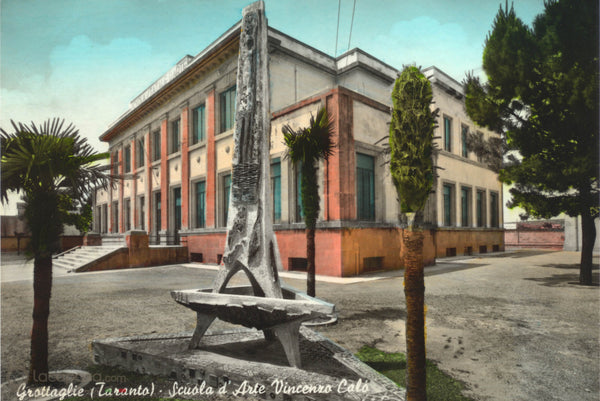
Manifattura Calò: machines support artisanal production
In 1910, Dr. Vincenzo Calò, a native of Grottaglie, founded an artistic and commercial ceramics factory in his villa, named “Manifattura Calò,” an interesting experiment in moving from entirely artisanal ceramic production to a manufacturing organization that used machinery to improve and increase production. In 1914, the factory was expanded until it became a fully fledged industry , employing more than fifty workers and operating in close collaboration with the School of Ceramic Art.
By the end of the 1920s, the factory’s products had reached foreign markets, especially the United States; the factory involved major Italian artists in ceramic production and won numerous national competitions. Today, artistic ceramics bearing the Fabbrica Calò mark are recognized as authentic works of art worthy of the world’s most prestigious auction houses.
The Ceramics Exhibition: Over 50 Years of Art and Craftsmanship
Since 1971, the artisanal and artistic ceramics of Grottaglie have been promoted through the annual Ceramics Exhibition , which attracts artists from all over the world. Each new edition features a different inspirational theme, which may be social or material in nature, but participating artists must use clay as their sole primary expressive medium. Different cultures, technical experimentation and messages reflecting diverse artistic sensibilities come together in this unmissable event.